
Who is the IAF?
By Quelia Phan
Think about the last meeting you sat through. Maybe someone talked over everyone else. Maybe the conversation went in circles. Maybe you left wondering why you were even there.
Now imagine a room where every voice is heard, where the group moves toward a shared goal, and where the outcome actually means something. That is what a facilitator makes possible, and the International Association of Facilitators (IAF) is the global home for the people who do it.
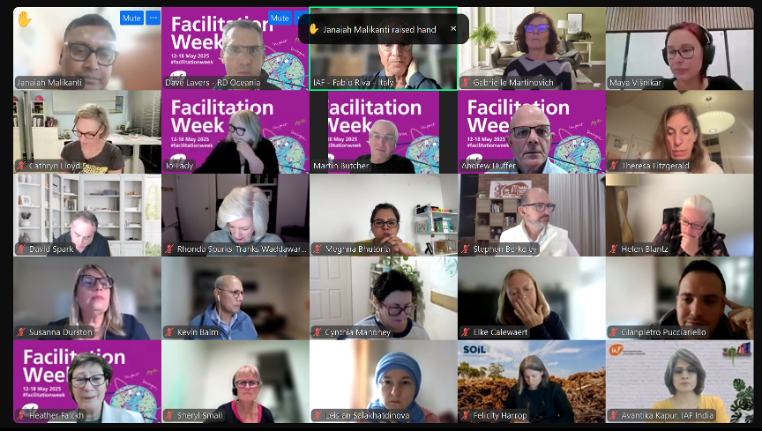
Facilitation Week 2025 sharing the power of facilitation.
Where Better Conversations Begin
Founded in 1994, the IAF has grown from a small group of practitioners into a global network spanning more than 60 countries, with around 2,000 members worldwide. Its purpose: to advance the art and profession of facilitation.
But what exactly is facilitation?
"We call ourselves process facilitators," says Dave Lavers, Regional Director and Secretary of IAF Oceania, "because unlike a trainer who might have a script, good facilitation is about listening to the group and creating the environment that allows the group to do the things it needs to do."
Linmin Zhang, IAF's Director of Professional Development based in Shenzhen, China, puts it differently. For her, facilitation is less about process and more about meaning. "Facilitation for me is like telling a story," she says. "The story lets the listener understand why it is important to them, and build the meaning for themselves.
A facilitator is not a trainer delivering content, nor a consultant with a ready-made solution. They are the person in the room who holds the space, making it possible for others to do their best thinking together.
Head, heart and hands
What makes the IAF more than a professional body is the culture at its heart.
Shalaka Gundi, Director of Conferences and Global Events based in Pune, India, describes it as "a beautiful blend of the head, heart and hands." The head is the cognitive work: competency frameworks, programs, awards. The heart is the warmth of a community that genuinely looks out for its members. The hands are the thousands of hours of volunteer work that keep the organisation running.
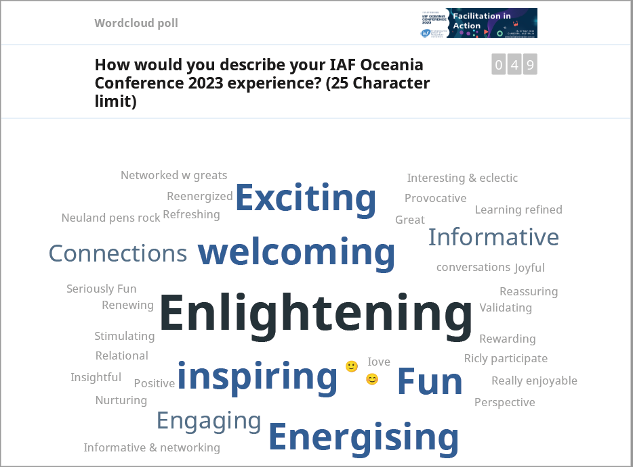
Word Cloud from IAF Oceania Conference 2023 the language of a community.
That spirit of generosity shows up in the small things too. Members share techniques, swap stories about sessions that went wrong, and practise new methods on each other. For Dave, who spent 19 years in the Australian Army before discovering facilitation in 2013, this sense of community was what kept him coming back. "Consistently," he says, "it is about the people."
The Making of a Professional Facilitator
At the centre of what IAF does is a set of six Core Competencies, a framework that defines what it means to facilitate well. They cover everything from building collaborative client relationships to creating participatory environments and guiding groups toward clear outcomes.
These competencies underpin the IAF's flagship credential: the Certified Professional Facilitator (CPF). Introduced in 1998, the CPF has been awarded to more than 1,500 facilitators across six continents. It is not simply a qualification. It is a reflection process.
Linmin spent around half a year working toward her certification, using the process to examine why some of her sessions landed and others did not. The experience changed how she approaches every workshop she runs. "It is like the North Star for me," she says of the Core Competencies. Dave, who earned his CPF in 2014, describes a similar shift: not new techniques, but a language for understanding what he was already doing.
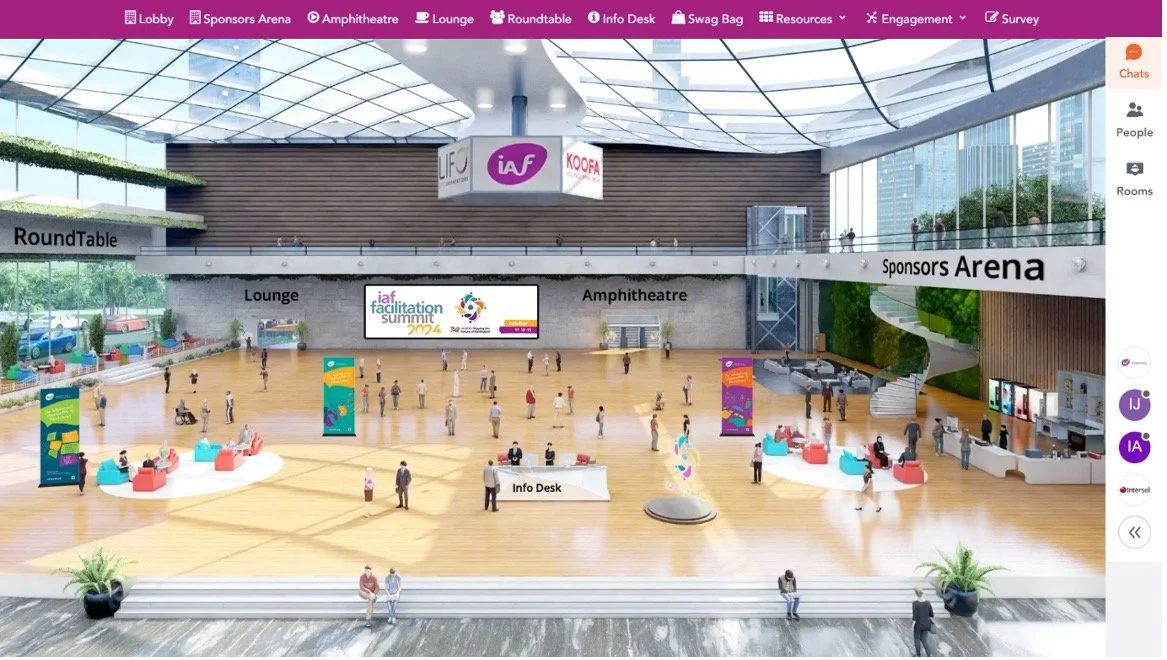
IAF Global Summit 2024 30 hours of facilitation over 3 days, celebrating 30 years of the IAF.
A global profession, a local community
One of the most striking things about the IAF is how a global organisation manages to feel genuinely personal.
Linmin and Shalaka have crossed paths at IAF events across the world: Bali, Lisbon, Monterey. Dave has seen them both on his travels, and it is clear these are not just professional connections. The two women speak about each other with the kind of warmth that is hard to manufacture. Linmin admires how thoroughly Shalaka prepares, how she tests every process before trusting it with a room. Shalaka, in turn, speaks about Linmin's generosity and her instinct for making people feel genuinely welcome.
"I would not have met her if it was not for the IAF," Dave says simply.
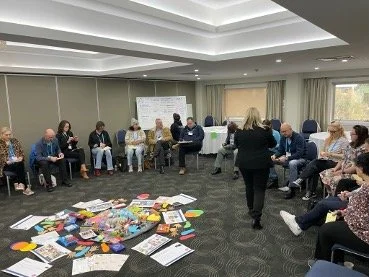
IAF Oceania Conference 2023: a workshop in progress.
When AI enters the room
Facilitation is not without its challenges. The rise of AI sits at the top of the list. Dave is honest about his concerns. Younger practitioners may find parts of their work automated before they have had a chance to develop them. But he is equally clear about what AI cannot replace: the moment when people from different backgrounds, speaking different languages, find a shared way of working together. "I am starting to think the language I speak is also facilitation," he says.
For Shalaka, the stakes are even broader. Facilitation, she argues, is not just a professional skill but a life skill, something that helps people connect more deeply at every stage of their lives.
The IAF is also reckoning with inclusion. Linmin, who works across Asia and beyond, speaks about the constant work of cultural adaptation. "I would not say I need to change something. I need to adapt. That is the deep respect of other cultures." The organisation recently re-launched its certification program in Mandarin and is preparing versions in Japanese and Spanish, a sign that facilitation as a profession is still growing into its own global ambitions.
---
What comes next
This October, the IAF Oceania Conference will bring facilitators together at Deakin University's Waterfront Campus in Geelong. For anyone curious about facilitation, Dave's advice is simple: "Just have a conversation with someone who is doing it. A lot of people start and they do not realise they are already doing the things that they are doing."
And if you are not sure where to begin? Shalaka puts it simply: "Everyone should learn facilitation. That is how you enjoy its power."
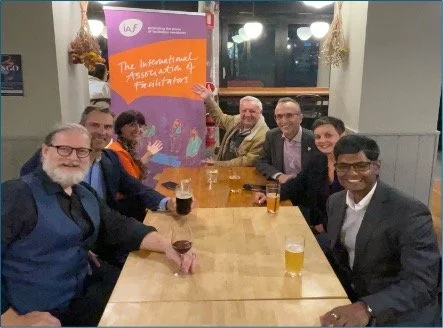
Social drinks at Facilitation Week 2025 - the connections that keep the community alive.
---
Quelia Phan is a journalism student at Deakin University, currently on placement with IAF Oceania. The IAF Oceania Conference 2026 takes place 14 to 16 October at Deakin University Waterfront Campus, Geelong. For more information, visit the conference page