
The Neuroscience Behind Great Facilitation
By David Spark
A facilitator can have an elegant process, a beautifully designed agenda and the right questions, yet still lose the room. Great facilitation depends on more than what we ask people to do. It depends on understanding what may be happening within them while they are doing it.
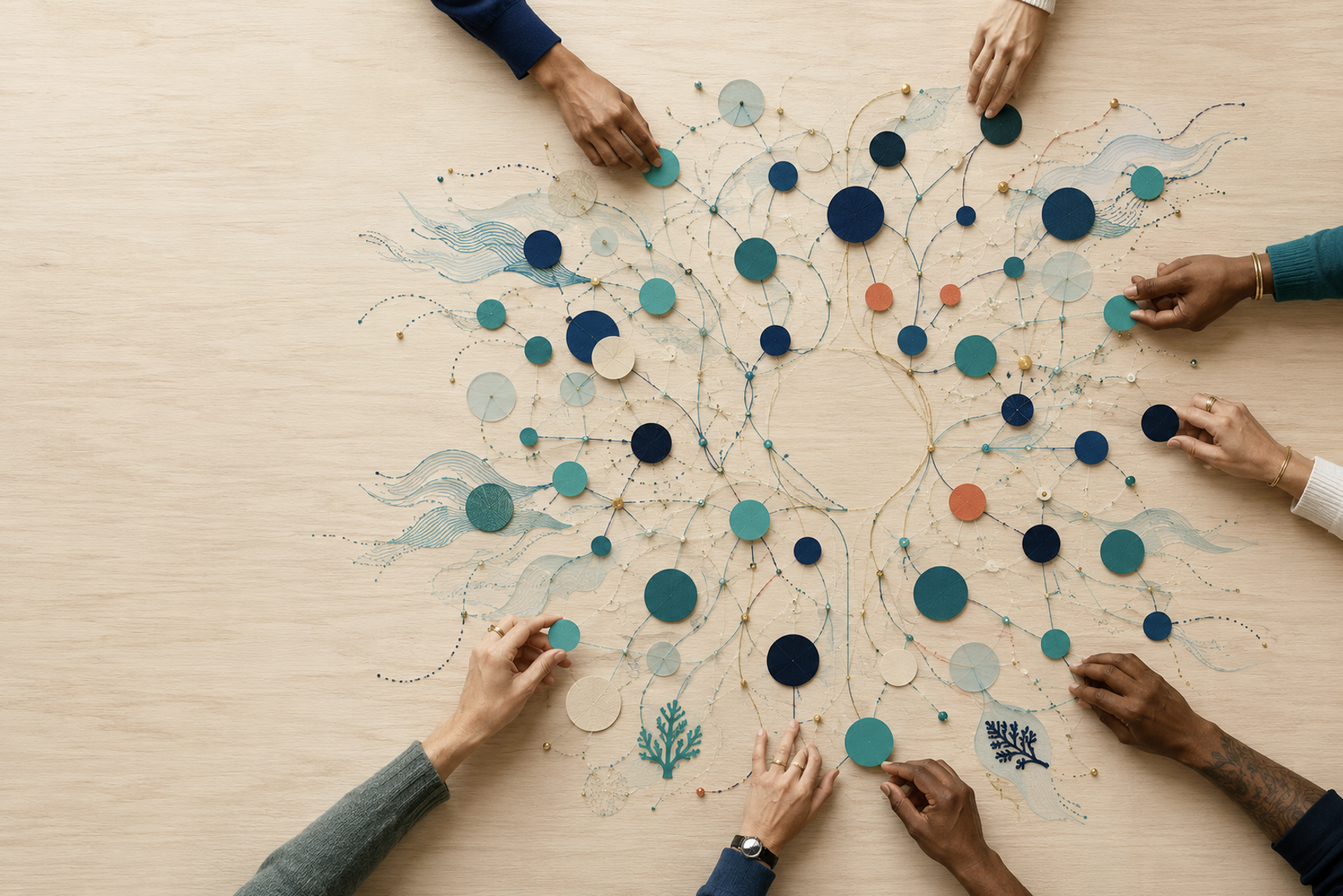
Every process meets a nervous system
Facilitators often concentrate on the visible architecture of a session: the sequence, timing, activities, materials and outputs. All of these matter. But beneath that visible process sits another system. Every participant arrives with a brain continually deciding what deserves attention, what feels safe enough to explore, what should be remembered and how much effort to invest.
This is why the same activity can energise one group and shut down another. A challenging question may create productive curiosity for one participant and social threat for another. An unexpected change may feel stimulating to some and disorienting to others. A room can appear quiet and compliant while participants are mentally overloaded, guarding their status or simply struggling to sustain attention.
Neuroscience does not allow a facilitator to read minds. Nor does it reduce people to predictable pieces of biology. What it can offer is a more disciplined way to think about attention, emotion, stress, learning and social interaction. Used carefully, it helps us design for human beings rather than for an imaginary, endlessly rational participant.
Attention is the first facilitation resource
Before people can reflect, learn or decide, their attention has to be available. Attention is limited and vulnerable to fatigue, distraction and overload. A session that asks participants to absorb too much information, hold too many instructions in mind or switch tasks repeatedly may exhaust the very capacity the facilitator needs.
A neuroscience-informed facilitator therefore treats attention as something to design for, not something to demand. They vary the rhythm of a session, provide clear transitions and allow time for participants to process before responding. They reduce unnecessary complexity, make the purpose of an activity visible and use breaks before the room reaches depletion.
The practical question shifts from, ‘How do I cover everything?’ to, ‘What do people most need to notice, think about and retain?’ That distinction alone can improve the quality of a workshop.
Emotion is part of thinking
Facilitation sometimes treats emotion as an interruption to the real work. Neuroscience gives us good reason to reject that separation. Emotion influences what captures attention, how experiences are encoded and retrieved, what feels significant and how people interpret social situations. Its effect is not uniformly helpful or harmful. Depending on intensity and context, emotion can sharpen learning or impair it.
For facilitators, this means the emotional climate of the room is not a soft extra. It is part of the learning and decision-making environment. Curiosity can invite exploration. A sense of progress can sustain effort. Shame, humiliation or excessive pressure can narrow participation and make self-protection more important than inquiry.
The task is not to keep everyone comfortable. Important work can involve tension, uncertainty and disagreement. The task is to create enough safety, clarity and relational trust for people to remain engaged with that difficulty rather than retreat from it.
The social brain is always in the room
Participants do not respond only to the content of a conversation. They also monitor status, belonging, fairness, autonomy and how they are being seen by others. A public challenge, a dismissive response or a process dominated by a few voices can alter the room quickly. People may become defensive, deferential or silent, even when they have valuable knowledge to contribute.
This is where neuroscience, emotional intelligence and facilitation practice begin to reinforce one another. The facilitator notices changes in energy and participation, regulates their own reactions and chooses interventions that lower unnecessary threat without avoiding the issue. They may change the sequence, move from plenary discussion to pairs, acknowledge uncertainty, invite anonymous input or make the decision rules clearer.
These are not tricks for manipulating people. They are ways of creating fairer conditions for thought and contribution.
From scientific insight to facilitation behaviour
Knowing the names of brain regions does not automatically make someone a better facilitator. The real value comes from translation: turning scientific insight into choices about behaviours, decisions and conversations.
That translation may mean designing shorter inputs and more active processing. It may mean giving people time to think privately before asking them to speak publicly. It may mean using emotion as information without allowing it to dictate the whole process. It may mean recognising when a group needs greater challenge and when it needs greater stability. It may also mean creating positive, high-performing cultures in which wellbeing and results are treated as mutually reinforcing rather than competing concerns.
Neuroscience is most useful when it sharpens observation and expands choice. It should make facilitators more curious and responsive, not more certain that they can explain every behaviour with a brain scan or a catchy model.
Learning with Sue Langley in Geelong
For facilitators who want to explore this connection in practice, The Neuroscience Behind Great Facilitation is a one-day IAF Oceania pre-conference workshop in Geelong on Monday 12 October 2026.
The workshop will be facilitated by Sue Langley, Founder and CEO of the Langley Group and an international thought leader in neuroscience, emotional intelligence and positive psychology. Participants will work with real scenarios and evidence-based frameworks, translating science into practical behaviours, decisions and conversations. The workshop is designed for facilitators, leaders, coaches, people and culture professionals, capability specialists and others who want to ground their practice more firmly in science.
At $600 plus GST per person, the workshop is being offered at a heavily reduced rate. This makes it a particularly valuable opportunity to learn directly from Sue and to examine how neuroscience can inform facilitation, culture and performance in an applied setting.
Participants are expected to leave with frameworks for positive, high-performing cultures, tools to strengthen emotional intelligence and wellbeing, and practical ways to apply neuroscience immediately.
Better questions about the room
The promise of neuroscience is not that it will give facilitators a perfect formula. Human beings and groups are too contextual, relational and complex for that. Its value is that it gives us better questions.
What is competing for attention? Where might cognitive load be too high? What emotions are shaping interpretation? What social risks are people calculating? Does the process provide enough clarity and autonomy? What could help this group remain open, curious and capable of learning together?
Great facilitators do more than move a group through an agenda. They create environments in which people can think, connect and contribute at their best. Understanding the neuroscience behind those conditions helps us become more intentional about how we create them.