
Better conversations, bigger impact: teaming up with a graphic recorder
By Ben Crothers, President of Graphic Recorders Australia
You’re putting together a proposal for a client’s strategy day. There’s a lot riding on the conversation, and you know a graphic recorder could help. But then that little voice pipes up: “That’s another fee. The client won’t have the budget.”
We get it. But before you leave graphic recording out of your proposal, let’s look at what it could contribute to the outcome you’re being hired to achieve.
What’s a graphic recorder, again…?
A graphic recorder (or live scribe, or visual note-taker) listens to a conversation and captures the essence in words and pictures, usually live, often on paper, a board or a tablet. All your participants can see their discussion taking shape: ideas, questions, relationships and decisions.
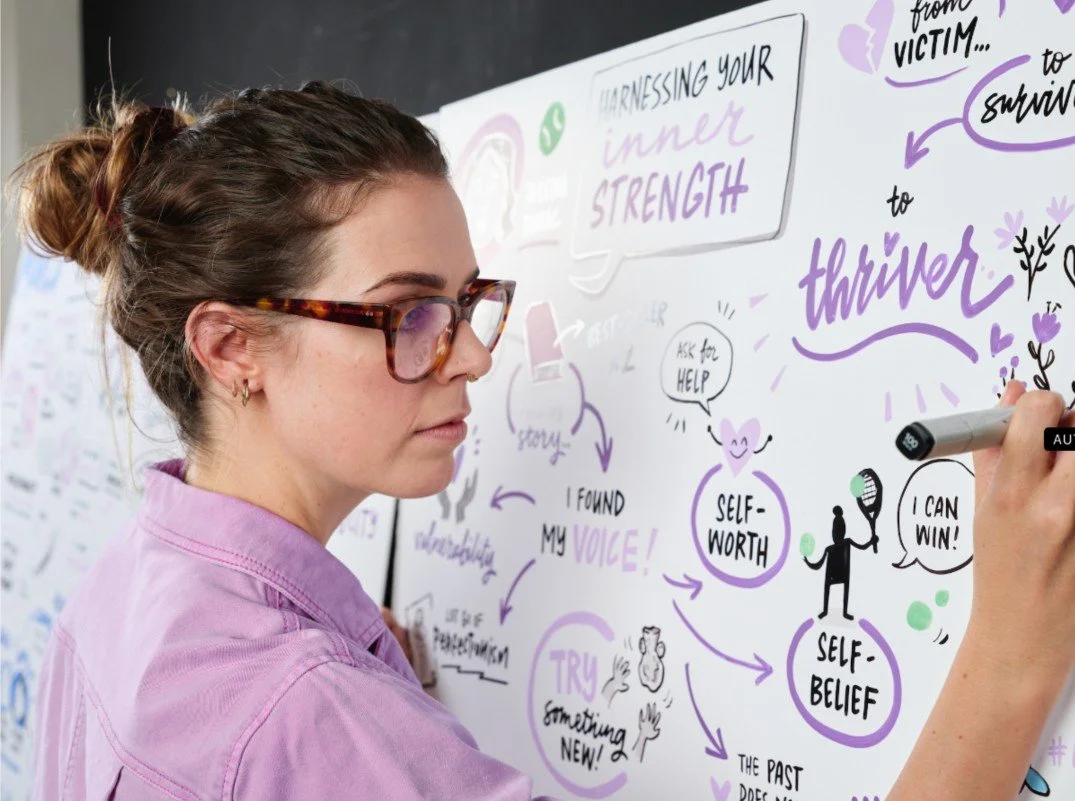
Melbourne-based Graphic Recorder Alice Edy
That visible record can become a useful part of your facilitation, as well as something worth taking away afterwards.
“Hey, we haven’t answered Erin’s question yet”
Recently, I worked alongside a freelance facilitator during a strategic planning conversation for an executive coaching consultancy.
The conversation meandered around, as they do. We moved from stars to weeds, as they say; from the current situation, future ambitions, details of offerings and questions about profitability. As I captured it, I grouped these topics into different areas on the whiteboard in the room.
Everyone could then look across the discussion and see connections that would have been much harder to follow through listening alone. They didn’t have to keep every point in their heads while considering the next one.
Something else happened, too. Knowing their contributions were being captured seemed to make people more intentional about what they said. And when someone raised a question that appeared on the board, others made sure the group answered it.
This is the bit that I really appreciated: what I drew helped the group take responsibility for its own conversation.
Benefits of graphic recording for you and your client
There’s something our brains love about watching a drawing unfold. People become curious about what will appear next, particularly when it represents something they’ve just said.
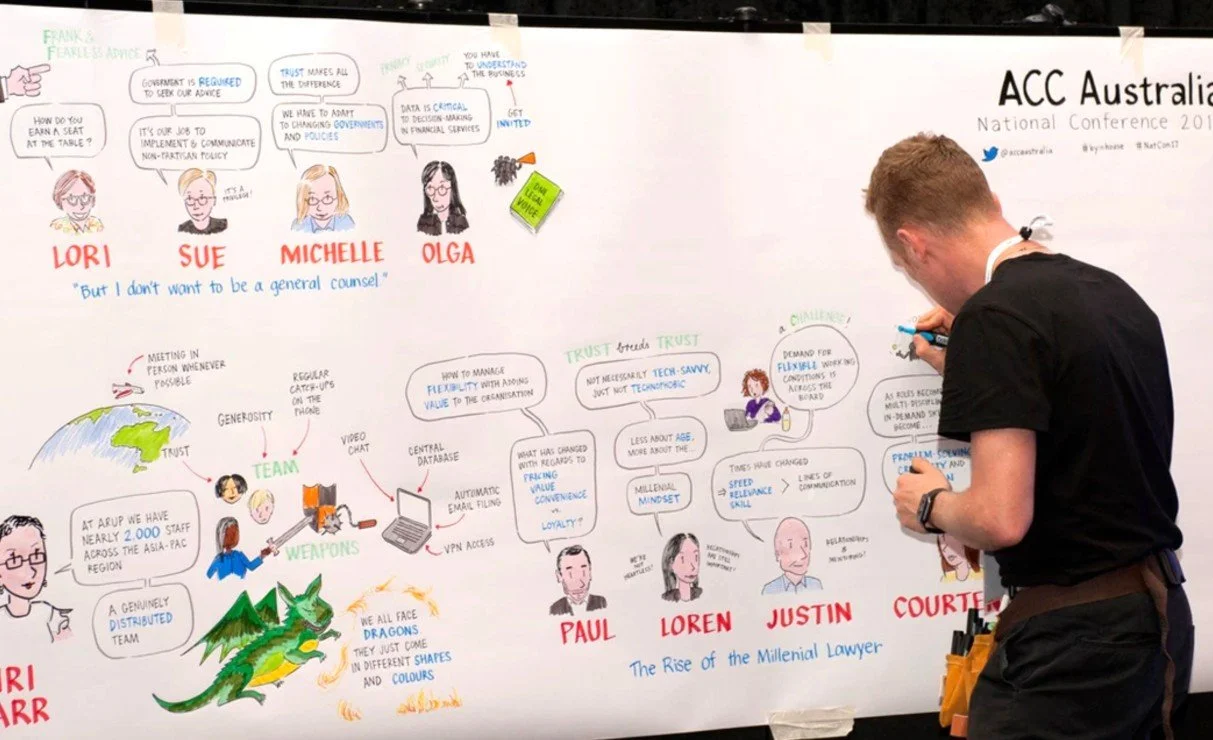
Graphic Recorder and GRA Treasurer Matt Magain
You can put that attention to work, and use it as part of your facilitation toolkit. Invite participants to check the capture, notice patterns, ask if something’s missing, or revisit an unresolved question. The visual becomes another way into the topic.
As Dave Allen, author of Getting Things Done said “Your mind is for having ideas, not holding them”. A cluster of concerns, an arrow between two ideas, or a clear distinction between today and tomorrow can help people follow the discussion and explain their thinking.
Seeing a contribution captured can be validating, too. Participants have evidence that someone listened. They can point to it, build on it or say, “Actually, that’s not quite what I meant.”
Visuals can also help across language and cultural differences (even differences between the Legal department and IT!), and graphic recorders are skilled in knowing which icons and metaphors will make sense to the people in the room, and which ones won’t.
Afterwards, the group has a visual summary it can share and revisit. I like to refer to it as a ‘postcard of the holiday we all went on together’; a reminder of the territory explored and what mattered.
For you, there’s another benefit. With a professional handling the visual capture, you have more freedom to watch participants, listen closely and respond to group dynamics. You also have a colleague to prepare and debrief with. Freelance facilitation can be a lonely ol’ game, and a good partnership really helps.
But will it distract people from my facilitation?
I hear this from clients and facilitators alike. Yes, people will look at the drawing. But remember: they’re looking at their conversation.
This is a massive opportunity for you as a facilitator to use the recording as a way to enhance engagement and progress in the room, with questions like:
“What connections can you see between these topics?”
“Which questions on the board still need answering?”
“Does this reflect what we’ve agreed?”
The graphic recorder will follow your facilitation rhythm. There might be times where it’s great for them to capture as much as possible, and other times where they don’t capture anything at all; that’s a great conversation you get to have together as you plan your event.
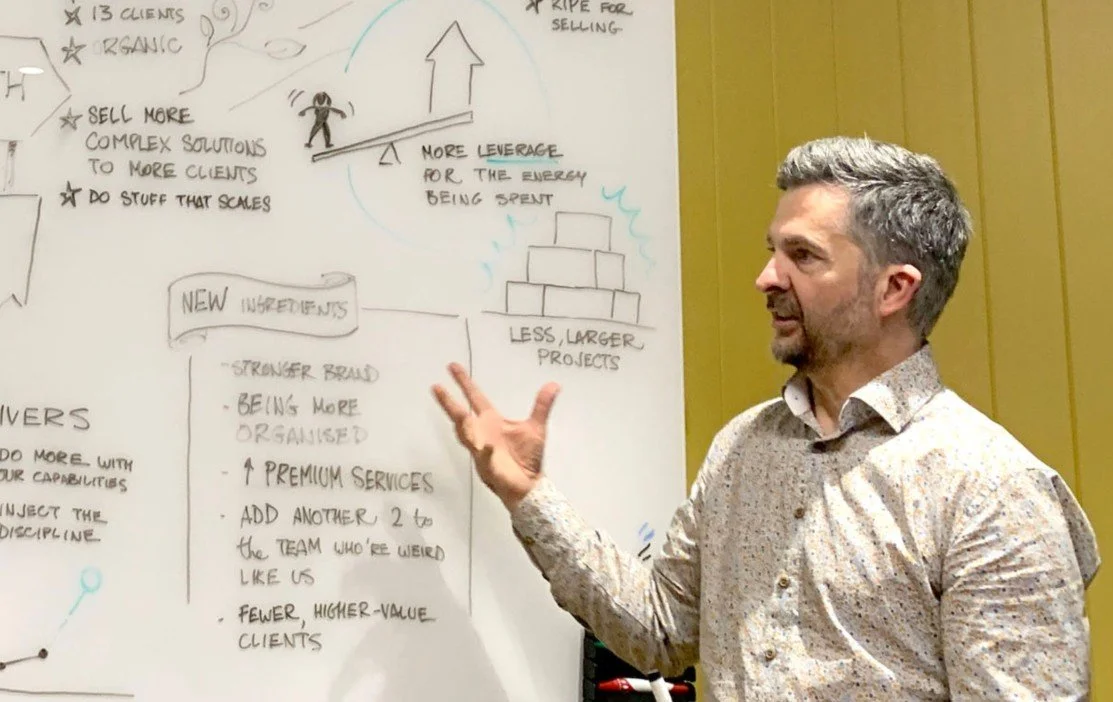
Graphic Recorder and GRA President Ben Crothers
But I already use flipcharts
Great! Your flipcharts may display the agenda and instructions, or capture ideas and decisions from different activities and tables. A graphic recorder can synthesise across those contributions and show how they relate. There are great ways to play team with this, and agree on who captures what so you avoid duplication, and play to your strengths.
But our subject is too technical
You can always share background material, terminology and the agenda with your graphic recorder beforehand. And, you can choose someone whose portfolio and experience suit the subject.
Graphic recorders vary; some are highly experienced in specific domains, like healthcare, public policy, or FinTech. Others have been at it for years, and know a lot about many different domains. The aim in a graphic recording is not to reproduce a technical white paper, but to make relationships between concepts much more understandable, while preserving the detail that matters.
But some of the conversation will be sensitive
Here’s where a graphic recorder is very different to a piece of software! You can instruct them on confidentiality, attribution, what should remain uncaptured, whether or not photos can be taken, and who can receive or publish the final image.
You probably need to make this clear to everyone at the event anyway, and your graphic recorder will be your back-up, to help make sure those necessary boundaries happen.
How to brief a graphic recorder for your proposal
OK, so you’re ready to include a graphic recorder – and their value – in your proposal. Start with (of course) articulating the client’s needs and potential risks. Where could people lose the thread? Which perspectives need connecting? What should participants understand or do afterwards?
If you think graphic recording will materially help, you can be specific about it, using those needs and risks. I’d say, include it in your recommended core package and explain its purpose.
When you need an estimate from a graphic recorder, brief them with the same brief you got, and discuss the session and your approach. You can discuss things like:
The session location, length, agenda, and topics
Preparation needed
Capture format - Paper? Board? Digital?
Client branding requirements
Room, equipment or technology requirements
Final deliverables needed, and turnaround time
Graphic recorders will love you if you also confirm any travel costs, and whether post-event revisions or additional assets are included. You can engage them as a subcontractor within your offering, with you remaining the client’s main contact. Allow for your coordination time as well as their fee.
You might use wording like this:
Facilitation and live visual capture
Our approach pairs facilitation with professional graphic recording. Throughout the session, all the main ideas, questions and decisions will be captured real-time as a visual map, helping participants follow the discussion, identify connections and check shared understanding.
The package includes a preparation briefing, live graphic recording during the agreed sessions, and a digital copy of the completed visual for internal sharing and follow-up.
Agree on branding, too. The graphic recorder might work under your business name or appear as a named collaborator. Either can work, provided you clarify credit, ownership and usage permissions beforehand. Any logo or promotional message should also suit the client’s intended use, of course.
And if the budget really is tight…
Some clients genuinely won’t have room for the full scope. If this is the case, you can ask which part of the gathering would benefit most: the whole day, the central strategic discussion, or the final synthesis?
There may be a smaller scope or another format worth exploring. Mind you, a shorter booking won’t necessarily reduce the fee proportionately, because preparation, travel and setup still take time.
It’s worth giving the client enough information to make a choice, and it helps them to actually understand the value of graphic recording as well. Explain the contribution and the cost, without promising that a drawing will magically pay for itself.
Come and meet your next collaborator!
Graphic Recorders Australia (link: https://graphicrecorders.org.au) will be at the IAF Oceania Conference 2026, from 14-16 October at Deakin University Waterfront Campus, Geelong. Come and meet us, see our work, and ask us all the practical questions, including the awkward budget ones!
Bring an upcoming project in mind. We’d love to explore how a graphic recorder could support you and your client.
You can also browse the GRA member directory (link: https://www.graphicrecorders.org.au/member-directory/?) or contact GRA (link: https://www.graphicrecorders.org.au/contact-us/) for guidance on general scope and fees and other resources.