
Reflections from IAF Oceania on presence, process, and our collective voice
By Sherona Parkinson and Nicholas Williams
Sometimes the best demonstrations of facilitation happen before a workshop even begins.
Just before Nicholas and Michelle Rush's session at the International Association of Facilitators (IAF) Oceania Conference in Geelong, we discovered that the handwritten instructions and workshop materials had gone missing. After some searching, they turned up in an unexpected place: a bin, caught up in the frantic clean-up between sessions!
A little generosity goes a long way
Sherona
I had arrived early to help set up. When we realised the materials were missing, Sam Bowtell (who had presented in the preceding session) and I set about finding them.
Fortunately, we tracked them down. Sam then decided to stay and take part in the workshop. Having helped rescue it, he now had a vested interest in seeing how it unfolded. It was a lovely reminder that people often become invested in something they've helped create. Thank you, Sam!
What struck me almost as much as Sam's generosity was the response to the disruption. There was no drama, just a wonderfully pragmatic attitude of "it is what it is". Nicholas and Michelle absorbed the stress and, when the session began, were fully present and ready to go.
It was a small moment, but it said something about the practice of facilitation: things don't always go to plan, and how we respond can matter just as much as the plan itself.
Nicholas
This was my first time facilitating a session at an IAF conference, so I'll take that calm response as a compliment!
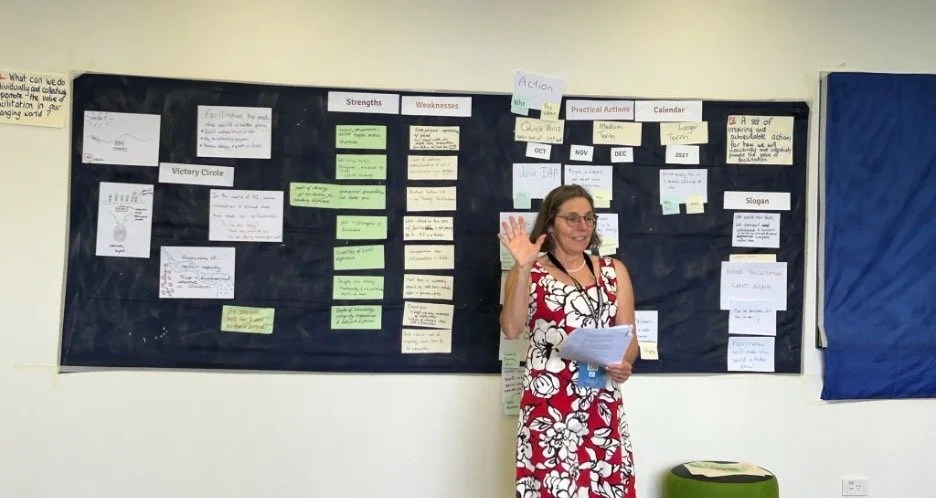
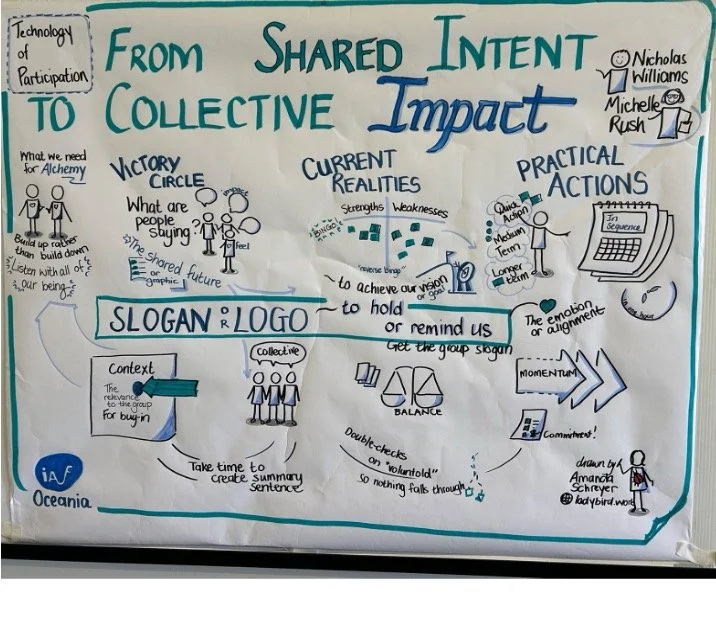
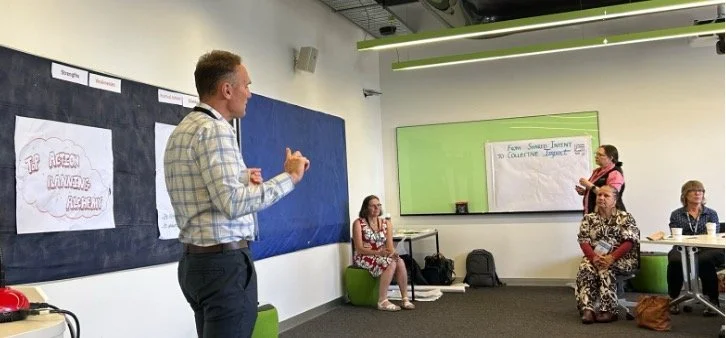
Alongside Michelle Rush, I facilitated ToP Action Planning Alchemy: From Shared Intent to Collective Impact. The session explored how Technology of Participation (ToP™) processes help groups move from shared understanding and aspirations to meaningful collective action.
We invited participants to explore three fundamental questions:
What is our desired future?
What is happening now that supports or inhibits this future?
What actions will we take to achieve it?
These questions provide a structured way for people to bring different perspectives together, build shared understanding and work towards action.
To begin, we shared a whakataukī (Māori proverb):
Whāia te iti kahurangi, ki te tūohu koe, me he maunga teitei.
Seek the treasure that you value most dearly; if you bow your head, let it be to a lofty mountain.
My mentor, the late Reverend Maurice Manawaroa Gray, taught me the importance of honouring people and place and opening with purpose. I've found including this in my facilitation practice helps centre and energise the group in their work together.
The response from participants after the session was wonderful. Several people told us how immediately applicable they'd found the process to their current work. One participant joked that Michelle and I had done ourselves a disservice: the session had been so impactful that they no longer felt they needed to attend any of our future training!
It's always rewarding to hear that a process has made a difference. Recognising the value of what we offer doesn't always come naturally to me, so I'm learning to pause, take that feedback in and appreciate how our work makes an impact.
When people experience the power of facilitation
Sherona
What happened after the session was just as telling as what happened during it.
Rather than heading straight to their next sessions, people gathered around Michelle and Nicholas, keen to continue the conversation. There was genuine curiosity, enthusiasm and a desire to explore more.
It reminded me how powerful it is to experience ToP rather than simply hear about it. Whether it's your first encounter or your fiftieth, there's something special about being part of a process that helps a group think together, find common ground and move towards action.
I also kept returning to the whakataukī. It felt like more than an opening to a planning session. It offered a reminder of how we might approach our work and our relationships with others, both in the room and beyond it.
Michelle and Nicholas demonstrated this throughout the session, not just in the way they guided the group, but in how they responded to the unexpected challenge before it even began. They didn't need everything to go to plan to create the conditions for a meaningful experience.
Perhaps that's one of the things that distinguishes good facilitation: being present, working with what emerges and trusting the process.
Beyond one workshop: the value of a connected community
Both of us
The conference was about more than one successful workshop. The generosity we saw extended throughout the event. Facilitators from across Australia, Aotearoa New Zealand and beyond shared their practice openly, welcomed newcomers and offered different perspectives on the work we do.
It was an opportunity to meet new people, reconnect with friends, learn together and continue collaborations that have been developing over the past 12 months to strengthen ToP offerings across Australasia.
It brought us back to a question that feels increasingly important for our profession: if facilitation can create such powerful experiences for groups, why is its value still so often overlooked?
As facilitators, leaders and members of teams, we've all experienced how good facilitation enables meaningful dialogue, helps groups navigate complexity and supports people to create change together. Yet the value of facilitation isn't always recognised. Nor is effective facilitation necessarily embedded in the everyday life of our workplaces and communities.
We do great work, and that work is itself an important demonstration of the value of facilitation. But too often, our stories, learning and evidence remain within the individual organisations and engagements where we work. We don't necessarily have a collective voice that is heard widely.
What can we do, individually and collectively, to promote the value of facilitation in our changing world?
What might change if we were more interconnected? Imagine if we shared our stories, our learning and our evidence more openly. If we celebrated one another's work, learned from our different approaches and championed the value of good process together, rather than one engagement at a time.
The conference offered a glimpse of what becomes possible when facilitators connect across organisations, sectors and countries. Ideas travelled quickly. People built on one another's experiences. New relationships formed. Knowledge that might otherwise have remained local became collective.
What if we found more ways to do that between conferences? This article is a small contribution to that effort: two perspectives on one experience, and an invitation to keep the conversation going.
Over to you
Perhaps building a stronger collective voice doesn't start with a grand strategy. Perhaps it starts with making the often-invisible aspects of our work a little more visible: sharing stories, documenting learning, celebrating good practice and helping others understand the role facilitation plays in creating meaningful outcomes.
Every conversation, article, case study and collaboration helps make that contribution easier to see.
Thank you to the IAF Oceania organisers for creating such an opportunity, and to everyone who joined the session and contributed to the conversations. And a big thank you to Amanda Schreyer from Ladybird at Work for being our Visual Scribe and collating such a fantastic reminder of what was discussed and co-created together during our session.
We'd love to hear from you:
What's one thing you're doing, or could do, to promote the value of facilitation? And what would help us become a more connected community with a stronger collective voice?
About the authors
Nicholas Williams is an Accredited ToP™ Trainer and Director of Facilitate Aotearoa.
Sherona Parkinson is a Certified ToP™ Facilitator with Enliven Dialogue.
Coming up: Nicholas Williams and Kevin Balm are delivering ToP training in Melbourne with ToP Australasia on 25–26 November. Find out more and register here using the code 'IAF Member' to receive a 10% discount: https://events.humanitix.com/foundations-of-top-methods
ToP Australasia is a collective of internationally accredited facilitators, coaches and trainers who have been delivering ToP™ facilitation and courses across Aotearoa NZ, Australia, India, China and the Pacific for more than 25 years.